

The Scale Says One Thing. The Blood Pressure Cuff Might Say Another.
Ask someone why they want to lose weight and the honest answer is rarely “I want a smaller number on the scale.” It’s usually something further downstream: lower blood pressure, better blood sugar, a waistline that doesn’t set off alarms at the doctor’s office. Weight is the proxy. The real target is what excess weight is doing to the body’s operating systems.
That distinction gets lost fast in coverage of tesofensine, a compound that keeps making headlines for how much weight it helped trial participants shed. Fair enough, that’s a real and notable finding. But it leaves the more useful question sitting unanswered: what happened to the markers people actually care about, the blood pressure readings, the fasting glucose, the waist tape measure, while all that weight was coming off? And does the answer change depending on who’s asking?
This piece works through what the published trial data actually say on that front, and where the picture gets more complicated than a simple “it helps” would suggest. Nothing here is for sale. Every claim traces back to a primary source.
The confusion: two effects pulling in different directions
Here’s where a lot of the confusion starts. Tesofensine isn’t a peptide and it isn’t a GLP-1 drug like semaglutide or tirzepatide, despite getting lumped into the same conversation. It’s a small molecule, originally developed under the name NS2330, and it works by blocking the reuptake of three neurotransmitters at once: serotonin, norepinephrine, and dopamine. That’s brain chemistry closer to certain antidepressants and stimulants than to the gut-hormone signaling that GLP-1 drugs rely on.
That mechanism is exactly why the metabolic story splits in two directions rather than one. The appetite-suppressing effect of extra norepinephrine and dopamine drives real weight loss, and weight loss in obese patients tends to drag other markers along with it in a good way: glucose handling improves, lipid profiles shift, waistlines shrink. That’s the half of the story most coverage focuses on.
But the same norepinephrine activity that suppresses appetite is also sympathomimetic. It can raise heart rate and blood pressure directly, on its own, with no weight loss required to explain it. So the compound is, at the same time, nudging some markers in a favorable direction through weight loss and pushing at least one marker, blood pressure, in the opposite direction through pure pharmacology. Any honest accounting of tesofensine’s metabolic effects has to hold both of those facts at once rather than picking the flattering half.
The clarification: what the trial data actually recorded
The main human evidence here comes from TIPO-1, a Phase 2b randomized, double-blind, placebo-controlled trial published in The Lancet in 2008. It followed 203 patients with a BMI of 30 to 40, all on a calorie-restricted diet, over 24 weeks, comparing placebo against tesofensine at 0.25, 0.5, and 1.0 mg once daily [P1]. The weight results were the headline: mean losses of 4.5%, 9.2%, and 10.6% across the three ascending doses, against 2.0% for placebo [P1].
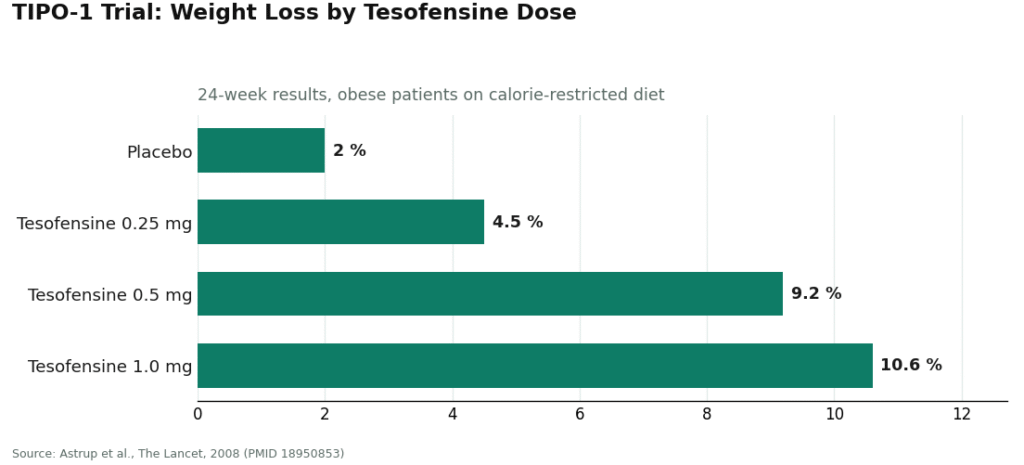
Weight loss of that scale in people carrying excess fat is generally the kind that moves other markers too, since waist circumference, fasting glucose, and lipid numbers tend to track with falling visceral fat. That’s the encouraging part of the record, and it’s real.
But the trial also documented the cost plainly. At the top 1.0 mg dose, blood pressure rose enough that the dose was dropped from further development. Heart rate climbed by roughly 7.4 bpm at the 0.5 mg dose [P1]. The two doses that moved forward into later planning, 0.25 and 0.5 mg, were chosen specifically because they kept the cardiovascular effects within a range considered tolerable. A separate 2008 meta-analysis in Obesity, pooling earlier trials run for Parkinson’s and Alzheimer’s disease, found the same pattern: heart rate rose in a dose-dependent way, by up to about 6.8 bpm, in patients who weren’t dieting and weren’t losing much weight at all [P2]. That detail matters more than it might first appear. If heart rate goes up even without meaningful weight loss to explain it, that isolates the effect as coming from the drug itself, not as a side effect of shedding pounds.
Reading the trade-off honestly
Put the two halves side by side and neither the enthusiastic version nor the dismissive version of this story holds up. It is genuinely a trade-off, and where it lands depends heavily on who’s taking the drug.
Picture two different patients. One carries excess visceral fat and has blood pressure that’s already well controlled. For that person, the weight loss tesofensine can produce may plausibly improve the markers that matter most to their health, with the heart-rate and blood-pressure changes as something to watch rather than something disqualifying. Now picture a second patient who already runs a fast heart rate, has borderline or elevated blood pressure, or has diagnosed cardiovascular disease. For that person, a drug that directly raises heart rate and blood pressure is working against the exact markers they most need protected, regardless of how much weight comes off. The benefit doesn’t automatically outweigh the cost for that patient, and assuming it does would be a mistake.
That’s the core reason this can’t be a self-directed decision. The net effect depends on a starting point that only a clinician reviewing an individual’s numbers can properly assess.
It’s also worth sitting with how thin the evidence base still is. The strongest human data on all of this comes from a single Phase 2 trial, and its own authors said the results “needed confirmation in phase III trials” [P1]. That confirmation hasn’t produced a US approval in the 17 years since. There’s no large outcomes trial showing tesofensine actually reduces heart attacks, strokes, or progression to diabetes, the kind of evidence GLP-1 drugs have slowly begun accumulating. So the fair summary is: plausible improvement in intermediate markers through weight loss, a documented direct cardiovascular cost, and no long-term proof yet either way.
Two more wrinkles worth knowing about
Two additional facts change how a clinician would actually approach this for someone focused on metabolic health.
First, because tesofensine raises serotonin, norepinephrine, and dopamine all at once, it shares chemistry with psychiatric medications, yet the public data on mood effects are thin, largely because the original obesity trials excluded anyone with a psychiatric history. The commonly reported side effects lean toward dry mouth, insomnia, nausea, headache, constipation, and diarrhea. The mood question isn’t answered so much as unexamined, which matters given how many people managing metabolic risk are also on medication for related conditions.
Second, the serotonin mechanism creates a real interaction risk. Combining tesofensine with an MAOI raises the risk of serotonin syndrome and a hypertensive crisis, and it overlaps dangerously with SSRIs, SNRIs, stimulants, and bupropion. For anyone with metabolic syndrome who might also be on an antidepressant, this isn’t a footnote. It’s a central reason a full medication review has to happen before anyone considers this drug, and a central reason going around that review is genuinely risky.
Where regulation stands, and why it matters here
Tesofensine is not FDA-approved for obesity, metabolic syndrome, or anything else. In the US it’s classified as an investigational new drug. Its furthest regulatory progress anywhere is a favorable technical-committee opinion from Mexico’s COFEPRIS in early 2023, which is a procedural step in one country, not an approval. Development rights passed from NeuroSearch to Saniona in 2014, and the most active late-stage work has continued through a partner in Mexico rather than through the FDA. For anyone hoping tesofensine will broadly improve their metabolic profile, that regulatory picture is a useful check: the case for secondary benefits rests on mechanism and one mid-stage trial, not on the dedicated cardiometabolic outcomes research that approval would eventually require.
The sensible path: supervision isn’t optional here
What makes tesofensine’s metabolic profile unusual is that it’s improving some things while directly worsening another, and the only way to know which way that nets out for a given person is to actually measure their cardiovascular markers before treatment starts and while it continues. That single fact determines where it makes sense to get this drug from.
A supervised telehealth setup is built for precisely that kind of ongoing check. FormBlends is a clear example of how this should work: a licensed telehealth provider, not a chemical seller, where tesofensine only becomes available after a clinician evaluation, a prescription when warranted, and dispensing through a licensed compounding pharmacy, running roughly $90 to $300 a month depending on dose. Because tesofensine is a small molecule rather than a peptide, it wasn’t caught up in the FDA’s peptide-compounding restrictions and remains available through licensed 503A compounding pharmacies with a prescription. For someone focused on metabolic markers specifically, that model has a concrete payoff: a clinician records a baseline heart rate and blood pressure, checks current medications against the interaction list, picks between 0.25 and 0.5 mg with that baseline in mind, and tracks the numbers over time. Patients who log their readings and symptoms between visits, using something like the FormBlends tracker app, give their clinician real data to work with instead of guesswork. That app is a logging tool. It isn’t a prescription and it isn’t a checkout.
HealthRX.com (healthrx.com) sits in the same supervised category, following the same basic logic: licensed clinical oversight first, dispensing through proper pharmacy channels rather than a bare chemical sale. Deciding between the two mostly comes down to which is licensed in a given state and which clinical process fits better.
The research-chemical route works entirely differently, and it’s a poor fit for exactly this drug. These sellers offer tesofensine labeled “for research use only,” with no clinician involved, no prescription, and no pharmacy standing behind what’s in the vial. For a drug whose entire metabolic value proposition depends on tracking two competing effects, an unmonitored vial in the mail defeats the purpose from the start. Nobody is checking the blood pressure it might be raising. Nobody is cross-referencing it against a medication list. And the product itself hasn’t been verified by the FDA for identity, strength, or purity, so even the dose is uncertain. A drug whose benefit depends on measurement is about the worst possible candidate for a route that measures nothing.
Common questions people ask
Does tesofensine improve blood sugar and cholesterol? The weight loss seen in obese trial participants would be expected to nudge markers like fasting glucose and lipids in a favorable direction, since those numbers generally move with falling visceral fat. But the strongest human evidence remains a single Phase 2 weight-loss trial rather than a study built specifically around cardiometabolic outcomes [P1]. Any improvement should be confirmed with actual lab monitoring, not assumed from the weight-loss numbers alone.
Does it raise blood pressure? Yes, and this is one of the better-documented findings. Blood pressure rose enough at the top 1.0 mg dose that it was dropped from further development, and the lower doses were selected specifically to keep blood pressure and heart rate in a tolerable range [P1]. The heart-rate increase also showed up in patients who weren’t dieting and weren’t losing meaningful weight, which points to a direct drug effect rather than something caused by the weight loss itself [P2].
Is it safe for someone with high blood pressure or heart disease? That’s the scenario where the trade-off tips against the drug, since it directly affects the markers such a patient most needs protected. This is a question for a clinician who can review actual cardiovascular history, not something to work out alone, and for many patients in this category the honest answer will be that the risk outweighs the benefit.
Is it FDA-approved for metabolic syndrome? No. Tesofensine isn’t FDA-approved for any condition and is currently classified in the US as an investigational new drug. There’s no dedicated long-term outcomes evidence showing it lowers cardiovascular events or prevents diabetes.
What is tesofensine, and how is it different from older weight-loss drugs?
Tesofensine is a triple monoamine reuptake inhibitor, meaning it slows how quickly the brain clears dopamine, serotonin, and norepinephrine. It was originally studied as a treatment for Parkinson’s disease, and researchers noticed significant appetite suppression as a side effect, which is what redirected its development toward obesity. Unlike older stimulants that hit a single target, its triple action appears to both reduce hunger and slightly raise resting energy output at the same time.
What does tesofensine actually do inside the body?
It raises circulating levels of three neurotransmitters by blocking the proteins that normally clear them from synapses. In trials, the reported effects included reduced appetite, modest increases in heart rate and blood pressure, and measurable drops in fasting blood glucose and waist circumference among participants with obesity. The cardiovascular changes are real and clinically meaningful, which is exactly why supervision matters before anyone considers using it.
Is tesofensine a peptide like semaglutide or tirzepatide?
No. Tesofensine is a small-molecule reuptake inhibitor, not a peptide. Peptide drugs such as GLP-1 receptor agonists mimic gut hormones and have to be injected because stomach acid would break them down otherwise. Tesofensine is taken orally and acts centrally in the brain rather than through gut hormone receptors. The two categories differ in mechanism, side-effect profile, and how much evidence backs them.
Where can someone access tesofensine legally, and what should they watch for?
Tesofensine hasn’t received FDA or EMA marketing approval as of this writing, so it isn’t sold through ordinary pharmacies. Some people access it through physician-supervised compounding pharmacies, such as FormBlends, where a licensed prescriber oversees dosing and tracks cardiovascular markers over time. Buying from unregulated research-chemical or supplement sites carries real risk: unknown purity, no accountability for dosing, and nobody watching if blood pressure or heart rate becomes a problem.
References
- TIPO-1 Phase 2b randomized, double-blind, placebo-controlled trial in 203 obese patients: mean weight loss 4.5% / 9.2% / 10.6% at 0.25 / 0.5 / 1.0 mg vs 2.0% placebo over 24 weeks; heart rate +7.4 bpm at 0.5 mg; blood-pressure rise at top dose; authors concluded the 0.5 mg result needs Phase 3 confirmation. Astrup et al., The Lancet, 2008. PMID 18950853. https://pubmed.ncbi.nlm.nih.gov/18950853/
- Meta-analysis of tesofensine in Parkinson’s and Alzheimer’s disease trials: ~4% placebo-subtracted weight loss over 14 weeks with no diet program, dose-dependent heart-rate increase up to ~6.8 bpm independent of weight loss. Astrup et al., Obesity (Silver Spring), 2008. PMID 18356831. https://pubmed.ncbi.nlm.nih.gov/18356831/
- PET imaging of dopamine transporter occupancy by tesofensine in humans: dose-dependent striatal DAT occupancy up to ~77%, supporting a dopaminergic contribution to its effects. Appel et al., European Neuropsychopharmacology, 2014. PMID 24239329.
- Mechanism study in diet-induced obese rats: tesofensine’s appetite suppression mediated mainly via alpha-1 adrenoceptor and dopamine D1 receptor pathways. Axel, Mikkelsen, Hansen, Neuropsychopharmacology, 2010. PMID 20200509.
- Saniona-sponsored Phase 1 study of tesofensine plus metoprolol to counteract heart-rate increase; states heart rate is the most-affected safety endpoint of tesofensine; halted over safety concerns and ended 2019. NCT03488719.
- Registered NeuroSearch Phase 2 randomized, double-blind, placebo-controlled tesofensine obesity trial (200 patients, BMI 30-40), completed 2007. NCT00394667.
